W5Reptilocracy 🦎🏛️ Rules for Thee, Not for Me
Teaser
The double standard wears the costume of consistency to protect our side when the rules are applied.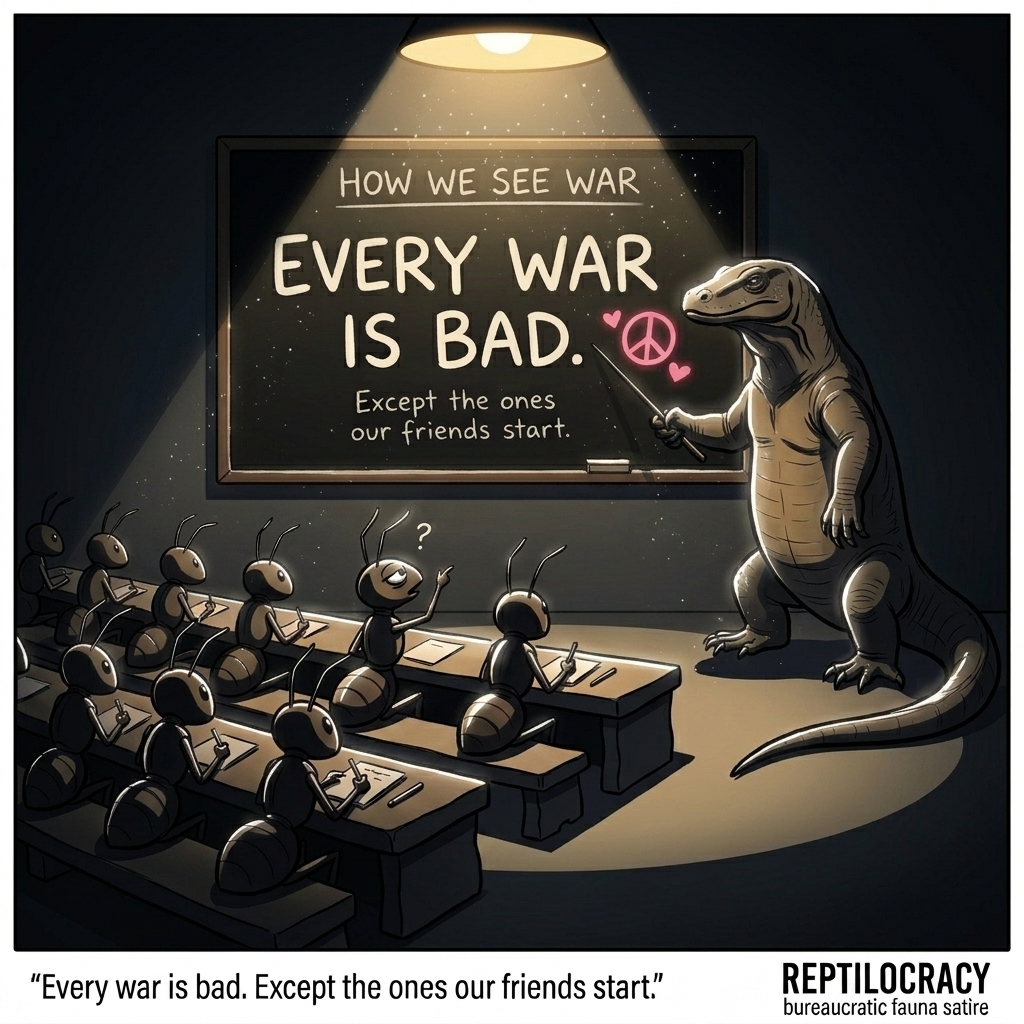
TLDR
We say every war is bad, then carve out an exception the moment our friends start one. The rule stays on the wall while the story around it gets rewritten.Context
Our brains judge the same action differently depending on who does it. Leaders frame “our” wars as necessary, defensive, or uniquely moral, while describing others as reckless or evil.
Social incentives reward loyalty to the in-group story, so repeating the double standard feels virtuous rather than dishonest. “Principles are firm until they touch our friends.” Without psychological fitness filters for honesty, courage, and resistance to status-driven self-deception, systems promote people who bend reality to protect the tribe instead of holding one standard for everyone.
BUT WHY:
This is part of an experiment: we are keeping count of how many scenes it takes before we agree that leaders with real power should prove they are psychologically fit to hold it.
By turning our instincts and hive habits into animals, the project asks why we still let untested nervous systems run entire societies.
In a world where one unstable nervous system can scale to entire institutions, this project treats Reptilocracy as the cartoon diagnosis and points to one concrete step: the Change.org petition (Stronger Checks and Balances: Psychological Fitness for Australia’s Top Leaders).