W6Reptilocracy 🦎🏛️ Now You See It, Now You Don't
Teaser
Leaders gain status by making bold commitments and then skillfully ‘forgetting’ them, treating our expectations as the real joke.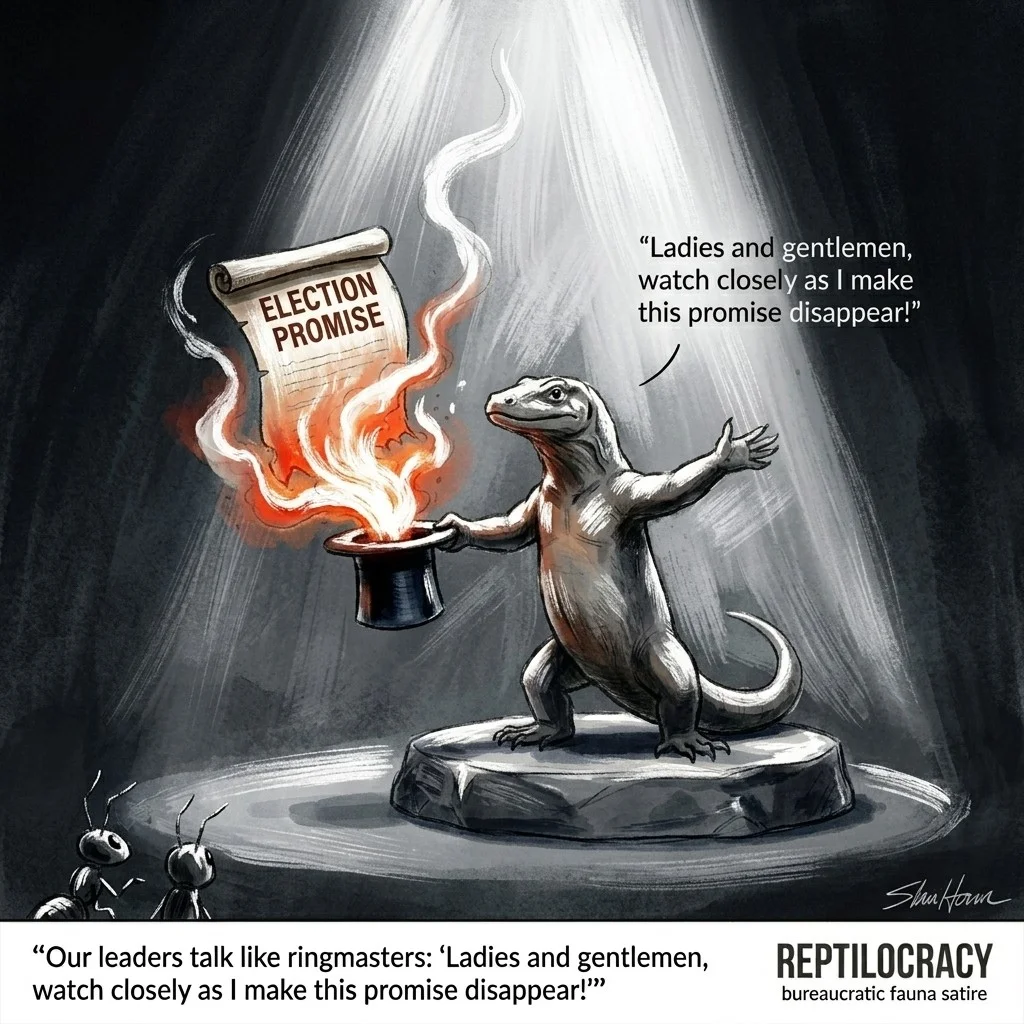
TLDR
We watch the campaign promise go into the hat and never come back out. The trick isn’t hiding the lie, it’s making us feel silly for expecting follow-through.Context
This scene shows narrative control wrapped in performance incentives: leaders gain status by making bold promises and then skillfully redefining, delaying, or “forgetting” them once in office. The audience attention span, media cycles, and fragmented responsibility make it safe to treat pledges as props rather than commitments.
Breaking the spirit of a promise becomes normal as long as you can defend the wording, blame events, or point to a partial gesture. “In politics, promises expire faster than the applause they earn.” Without psychological fitness filters for honesty, accountability, and the ability to face short-term pain to keep long-term commitments, systems promote performers who manage perception instead of stewards who honor their word.
BUT WHY:
This is part of an experiment: we are keeping count of how many scenes it takes before we agree that leaders with real power should prove they are psychologically fit to hold it.
By turning our instincts and hive habits into animals, the project asks why we still let untested nervous systems run entire societies.
In a world where one unstable nervous system can scale to entire institutions, this project treats Reptilocracy as the cartoon diagnosis and points to one concrete step: the Change.org petition (Stronger Checks and Balances: Psychological Fitness for Australia’s Top Leaders).