W6.1Reptilocracy 🦎🏛️ Safest Self, Smallest Self
Teaser
You learn which gestures get flagged, which questions get you pulled into a meeting, which ideas stall your promotion. Narrative control sells the shrink as maturity.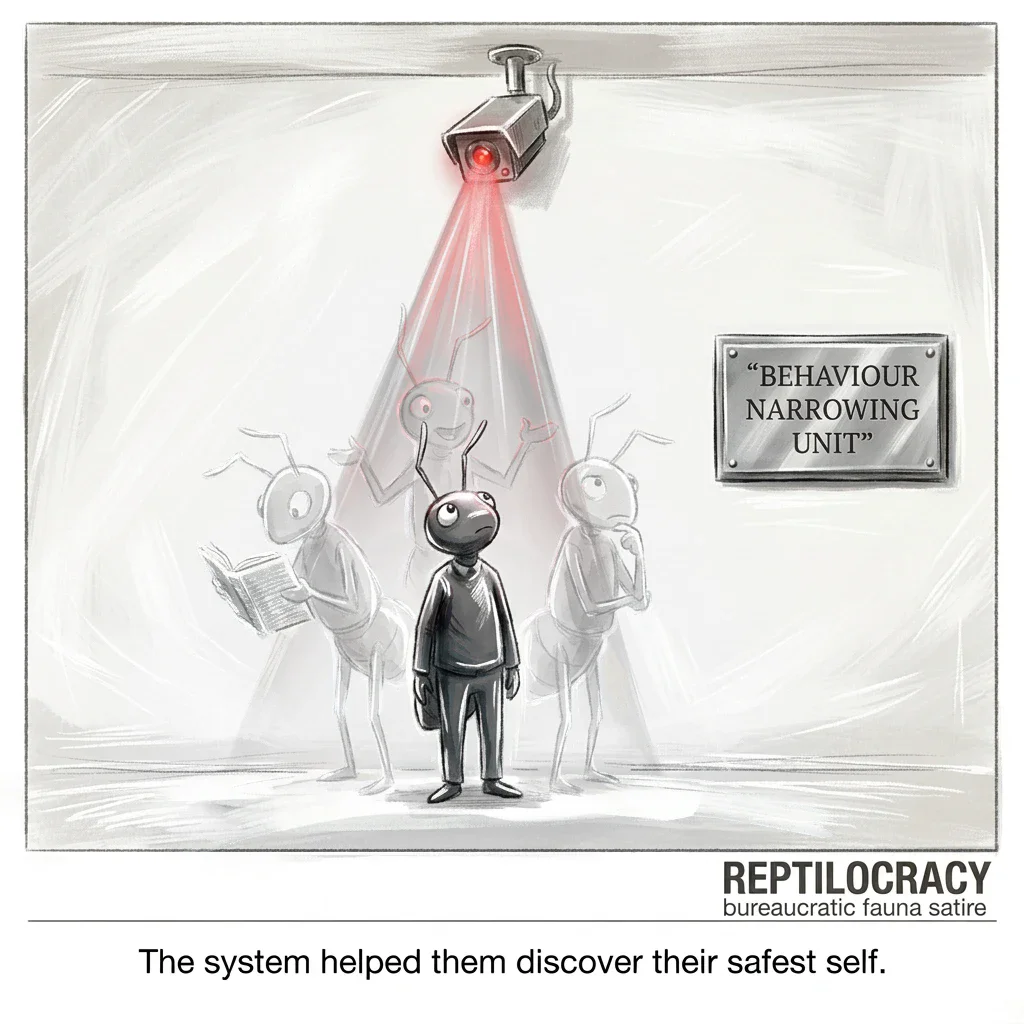
TLDR
Under the red camera beam, we drop quirks, doubts, and experiments until only the safest version of us remains. The system calls it compliance; our nervous system feels it as shrinking.Context
Constant monitoring plus fear chains teach us fast; we quietly drop the rest to protect status and income.
Surveillance doesn’t need to watch everyone. It teaches everyone to watch themselves. Narrative control reframes that self-edit as “professionalism,” “risk management,” or “behaving appropriately,” so the loss of range looks like maturity instead of fear. “When being safe means being small, the system wins by subtraction.” If no one screens for people who can speak plainly under pressure, the cautious rise. They manage by watching and narrowing, not by trusting.
BUT WHY:
This is part of an experiment: we are keeping count of how many scenes it takes before we agree that leaders with real power should prove they are psychologically fit to hold it.
By turning our instincts and hive habits into animals, the project asks why we still let untested nervous systems run entire societies.
In a world where one unstable nervous system can scale to entire institutions, this project treats Reptilocracy as the cartoon diagnosis and points to one concrete step: the Change.org petition (Stronger Checks and Balances: Psychological Fitness for Australia’s Top Leaders).