🏢🔺 Why does every group organize into a pyramid?
Claim
Brains compress the world into layers and rank, route attention upward, so local noise gets summarized before it reaches a decision. That is why pyramid-like groups feel obvious: a few signals at the top, many roles below, a ladder everyone can read. Hierarchy is an attractor, not destiny. Flatter systems need counter-design because the nervous system is already used to climbing.Thoughts
Families get elders. Classrooms get teachers. Armies get ranks. Companies get managers. Online communities get moderators, influencers, and inner circles, even when they begin with flat ideals.
Culture and greed matter, but the deeper reason starts inside the body: the human brain already stacks the world in layers.
Perception, action, language, and social meaning all run in layers. Low-level signals get grouped into patterns, patterns get grouped into concepts, and concepts get routed through systems that decide what matters next.
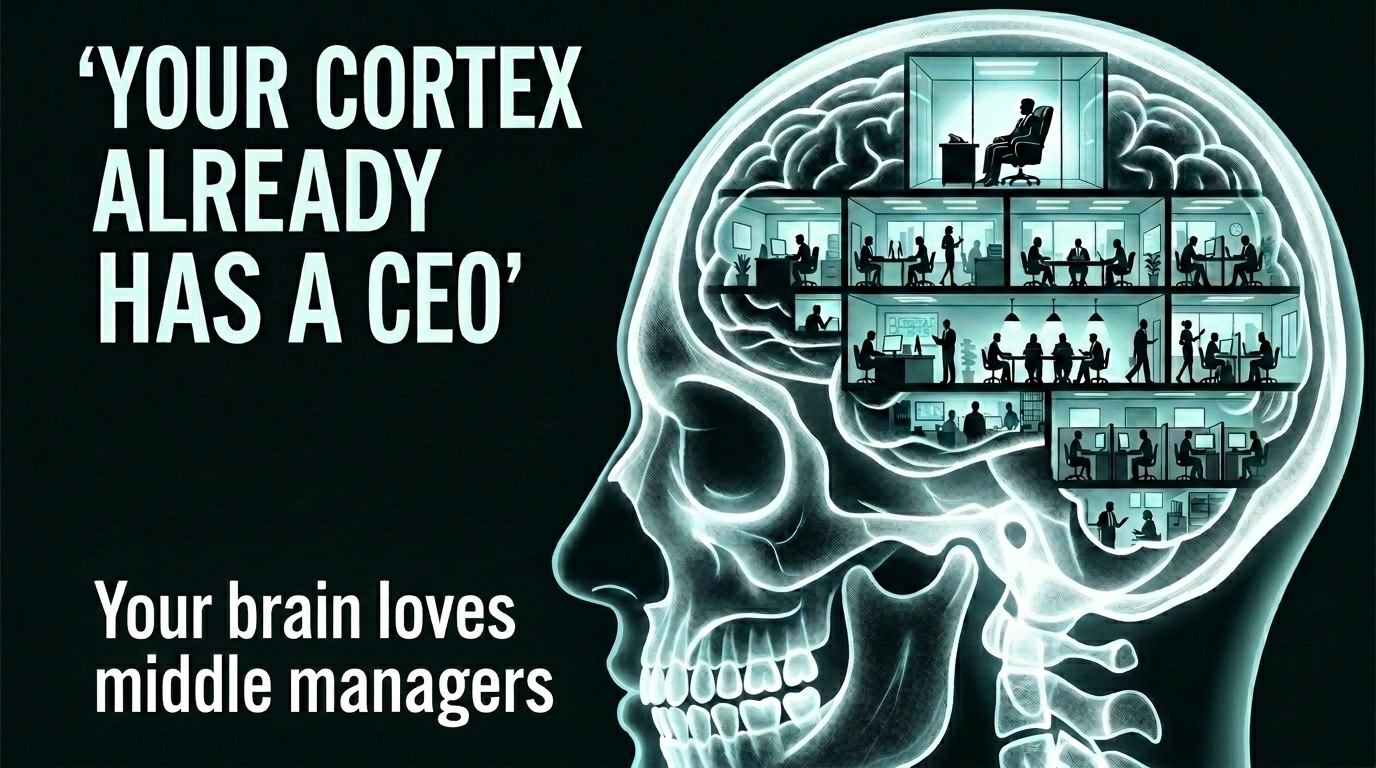
Your cortex stacks bosses before HR does
The cortex (the brain’s outer wrinkled layer) stacks work in layers. Sensory systems move from simple features toward richer abstractions. Motor systems stack local movement under broader action plans. Executive systems (the brain networks that set and hold goals) hold goals above immediate impulses.
The brain solves complexity by building nested control: local systems do local work, while higher systems compress, compare, and redirect. No tiny king sits at the top; nested control spreads authority across layers.
If you can track which sound matters, which movement matters, and which goal overrides which impulse, you can also track rank in the room: whose anger matters, whose approval changes your options, and whose signal reorganizes the room.
Rank in the skull before the org chart
Zink et al. ran a lab game where volunteers learned who outranked whom from other players’ faces alone. When their rank rose or fell, brain scans lit the same reward and control networks that respond to money. A team of ten can run on memory, trust, and direct talk. At company scale, signals and disputes outrun that. The group trades detail for speed through fewer paths up the chain: one report line, one roll-up, one answer upstairs.
Ten people spoke in a cross-team planning meeting; the VP got one bullet from a skip-level report (one level above your manager), trimmed by a director, shaped by whoever could block the roadmap.
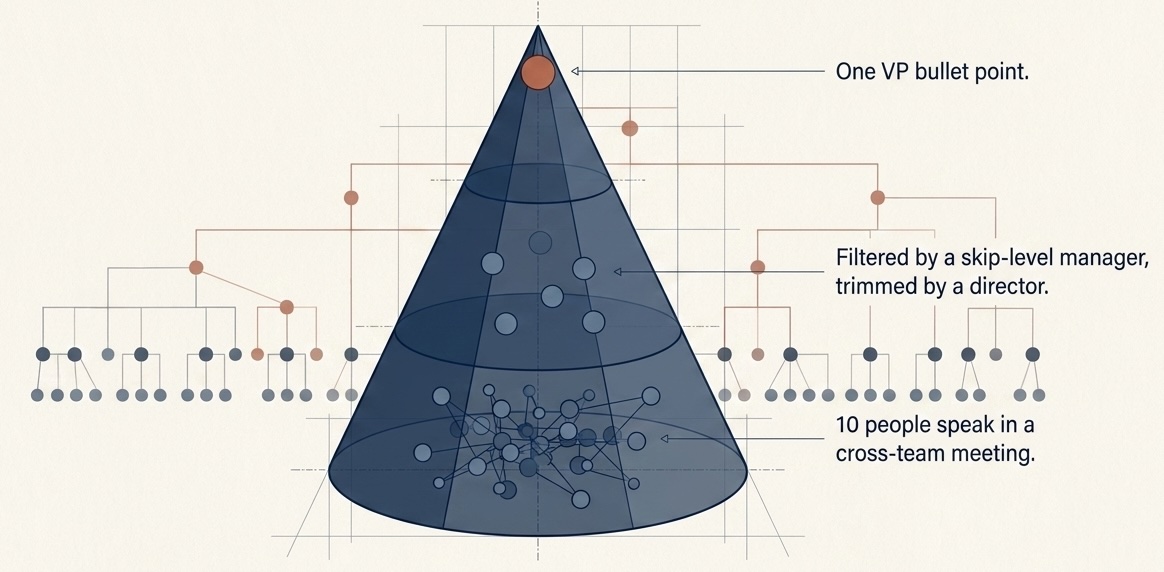
Pyramids compress many local realities into fewer steering points (easier to steer, blame, and obey) but breed bottlenecks, status games, and a gap between the person who decides and the people who eat the cost. The ladder that coordinates can teach thinking stops at your layer.
Built-in bias, not hard fate
Brains can handle networks, rotating roles, and heterarchies: the lead changes by domain (finance vs product), not one fixed boss chain for every call. Humans can design councils, juries, cooperatives, and other forms that resist simple top-down control.
Flatter systems need explicit counter-design: rules, shared maps, transparent decisions, and norms that stop rank from silently reappearing. You see it in co-ops and open-source projects that last: written processes, visible decisions, rotation of who can merge.
On paper, a startup can be flat. In practice, the room orbits the founder. A forum can ban visible ranks and still orbit the mod with the delete button. Without that counter-design, hierarchy returns because it is easy to read, imitate, and justify once it exists.
We keep building pyramids because attention already climbs in layers.