💆💭 Can you feel yourself thinking?
Claim
Touch and thought run on the same perceptual machinery, but you get two different felt assignments: the world on your hand, the operator in your head. You can’t even get close to thinking with an elbow. That asymmetry should unsettle you more than it does.Thoughts
Your brain runs the whole show, but you never feel it doing anything. The brain hides and hands you a clean story: “that’s the world, that’s your body.”
When you touch something, the world sits on your skin, not in your skull. That felt location is what your brain says your hand is.
Where does the operator sit?
When you think, the location illusion cracks a little. You don’t say your knee had an idea. You don’t credit your shoulder with a plan. The sense of “me” gets glued to your head, like that’s where the operator sits.
When you think, the operator stays behind your eyes, not in your hand. That felt assignment is what your brain says your head is.
Same system, two tricks: the world on your hand, the operator in your head. You never feel the swap. The story just feels natural.
What if the anchor had to move?
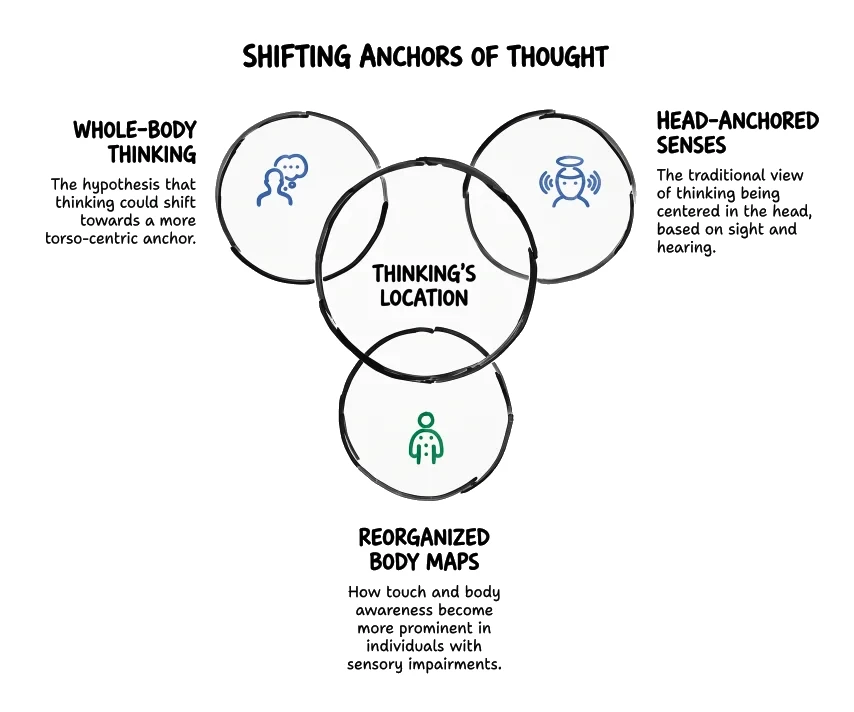
For you, thinking feels head-shaped because the sense of “me” trained itself on head-anchored senses: eyes, ears, balance.
In people who are blind or deafblind, touch and body sense already reorganize and pick up more of the work left by missing sight or hearing. Their body maps and self-location machinery do not match the standard sighted, hearing template. On that evidence, the felt anchor may move from the skull to the torso or the whole body. Nobody has directly measured that yet.
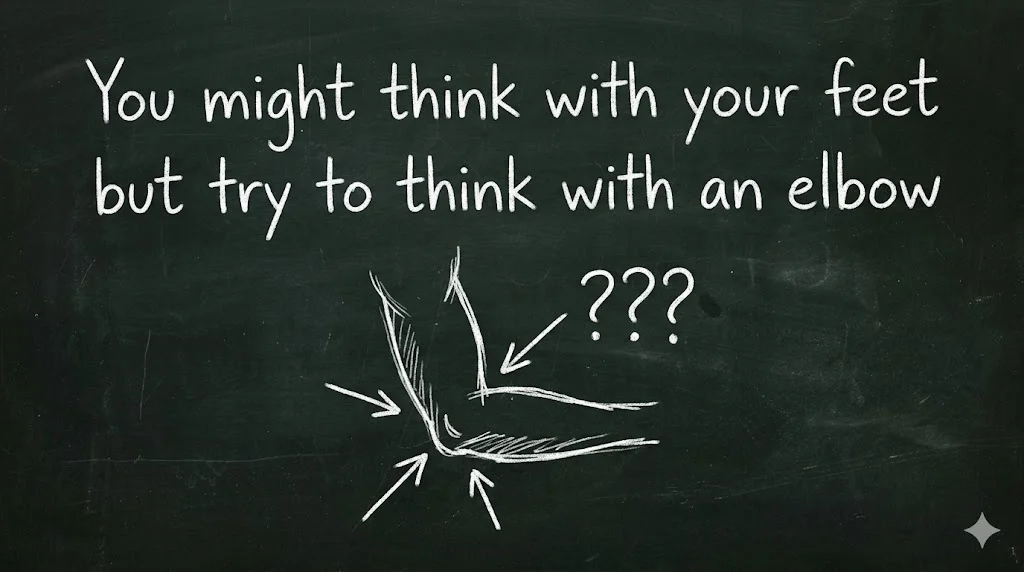
Try to think with an elbow
Press your elbow to the desk. Try to feel the next thought start in the joint.
The skin reports pressure, not a speaker. The words still land behind your eyes, same place as always.
The elbow says absolutely nothing.