🦑🧠 You think you think?
Claim
When tools draft, sort, and summarize for you, they mostly eat the habit plane: inherited conclusions, reactive loops, cognition that runs like muscle memory. What stays yours is the metacognition plane: noticing which parts you outsourced, and learning to think ahead of your thoughts.Thoughts
People say AI is taking our thinking. That is partly right. It may only be right on the habit plane. We still have to think; we just have to do it on the metacognition plane.
When “thinking” is someone else’s script
A lot of what we call thinking right now is following someone else’s thinking without giving it real thought. Opinions arrive pre-packaged. Reactions fire before you ask why. Mental habits run like muscle memory.
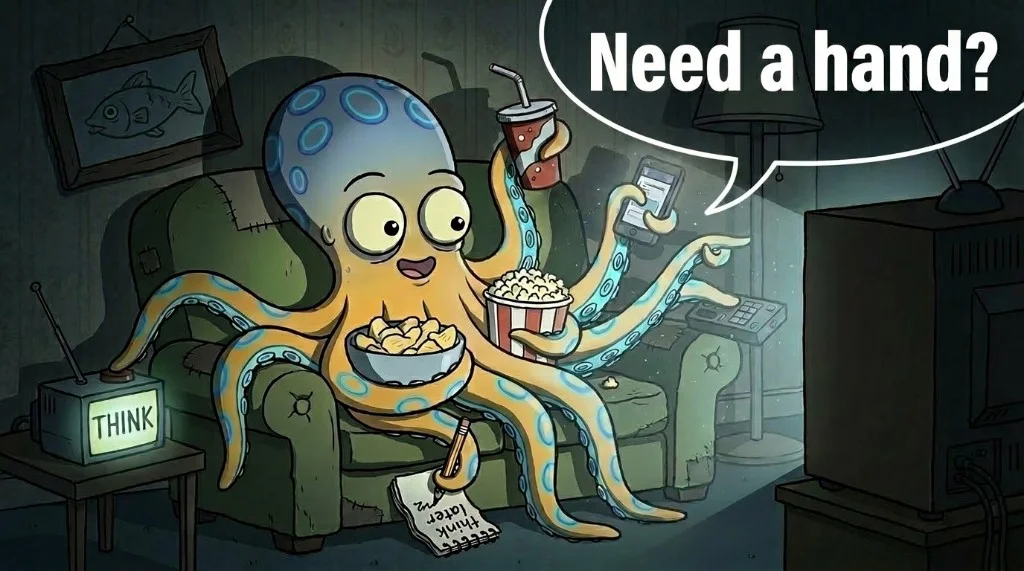
In that sense we are less like a single, unified mind and more like an octopus.
Arms that think locally
An octopus does not keep all of its intelligence in one central brain. Its arms have their own dense clusters of neurons. They can explore, grasp, and decide almost independently, while the main brain only gets involved when it really matters.
Our days work the same way. The routine arms of the day (scrolling, reacting, following routines, letting AI draft and sort and summarize) run on local programs. They do not need much conscious oversight.
Artificial tentacles
We hand some of those tasks to artificial tentacles: recommendation systems, large language models, planning tools. Extra arms reaching into the world on our behalf.
That shifts work from mechanical execution to choosing among many drafts at once. A designer who once spent nine hours manually moving elements on a screen now lets the limbs move the pieces at scale. The effort remains, but the mind evaluates a dozen proofs-of-concept simultaneously. You work at the speed of selection.
The tragedy is treating every arm as the whole mind, then wondering why nothing inside feels awake.
Arm moving vs mind waking up
There is still a difference between an arm moving and a mind waking up.
You can let your human and artificial arms run while you sit back and watch TV, without a thought. Or you can become more like the octopus brain watching its own limbs: track which arms you outsourced and which you abandoned.
Thinking ahead of your thoughts means directing this parallel spread. You set the target, let the artificial limbs map the territory, and select the pattern that hits the mark.