🧠 Antisocial wiring is human. Why is it so hard to name?

Claim
Antisocial and psychopathic traits sit across the human range of emotion, reward, and social processing. Under DSM rules, antisocial personality disorder only counts if there were behavior problems before age 15. Miss that childhood record and the adult pattern can still be there, with real costs, and still get no diagnosis. Naming that wiring is how we measure it, treat it, and build guardrails around it.Thoughts
Society now names some configurations out loud: Autism. ADHD. Dyslexia. Non-binary. Neurodivergent. We can name them, debate them, and sometimes even build support around them.
Psychopathy (low guilt, shallow affect, high reward-seeking) and antisocial patterns do not even count as neurodivergent. They still live mostly in taboo: horror genre, true-crime hook, synonym for evil. These traits sit on a dimensional distribution (a gradual range across people) of emotion, reward, and social processing. They are part of human nature: another interesting and recurring configuration of mind.
When a configuration stays unspeakable, it goes unmeasured, underfunded, untreated, and unmanaged.
Two paths, similar overall configuration
Researchers often map this range as two clusters. They can look alike from the outside. The origin and the paper trail usually do not.
Factor 1 (primary): low guilt, shallow affect, callousness, manipulativeness, low fear; more often a born-in setup. In some rooms that reads as confidence, dominance, or charm. Quiet trail.
Factor 2 (secondary): impulsivity, unstable life patterns, rule-breaking, aggression. More often framed as shaped by environment: trauma, chaos, learning that harm works. That trail is louder: arrests, firings, childhood misconduct on file. Everyday talk of “sociopathy” usually points here. Clinical manuals lean this way too when they diagnose antisocial personality disorder (ASPD).
Who we count depends on the childhood file
Under DSM, antisocial personality disorder (ASPD) requires behavior problems before age 15 and childhood conduct disorder (repeated aggression, rule-breaking, or property harm in youth) on the record. Problems that start at 16 or 30 do not open the door: same adult pattern, no ASPD label.
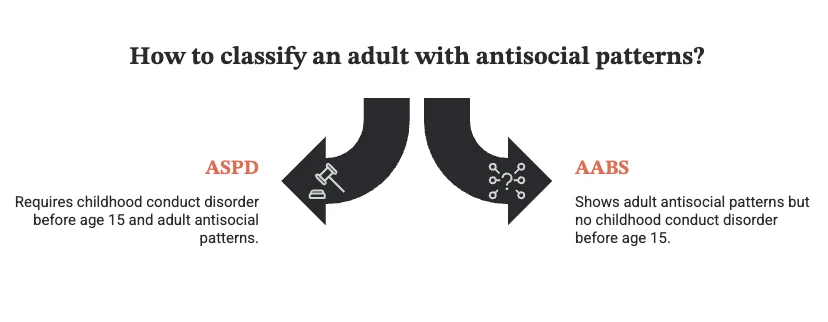
A large U.S. survey (NESARC-III, 36,309 adults) sorted people into two buckets. About 4.3% met full antisocial personality disorder (ASPD) criteria: the adult pattern plus childhood misconduct on record. Another 20.3% showed the same adult pattern with no childhood conduct disorder before 15. Researchers called that second group adult antisocial behavioral syndrome (AABS). Add the buckets and you get roughly one in four U.S. adults with a significant antisocial pattern; most never treated. AABS matches ASPD on impairment (job loss, relationships, substance use, crime) but often gets relabeled.
That is a bureaucracy problem, a measurement gap. Similar adult pattern, different paperwork, different treatment pathways, different place in the public-health story. This configuration belongs at the same table as neurodivergence. Who absorbs the harm differs: with autism or ADHD, the person often pays when systems misread them; with antisocial patterns, harm can land outward on families, workplaces, and institutions. Naming that difference is how you design support, boundaries, and honest research.
The clean file is the blind spot
We treat antisocial patterns as a crime story. The risk that moves policy, markets, and care systems is often the clean-file version: Factor 1 in boardrooms, legislatures, and bureaucracies, no childhood misconduct on record, no ASPD label. Low guilt reads as decisiveness. Manipulation reads as politics.
We fund the loud Factor 2 trail. The quiet trail keeps the title, the budget, and the agenda.
When the elephant is sitting in the middle of the dining table, you name it. Measure it. Build guardrails. Skip romance. Skip the moral cartoon.