🧬🧠 Memes jump mind to mind, then make you defend them like identity
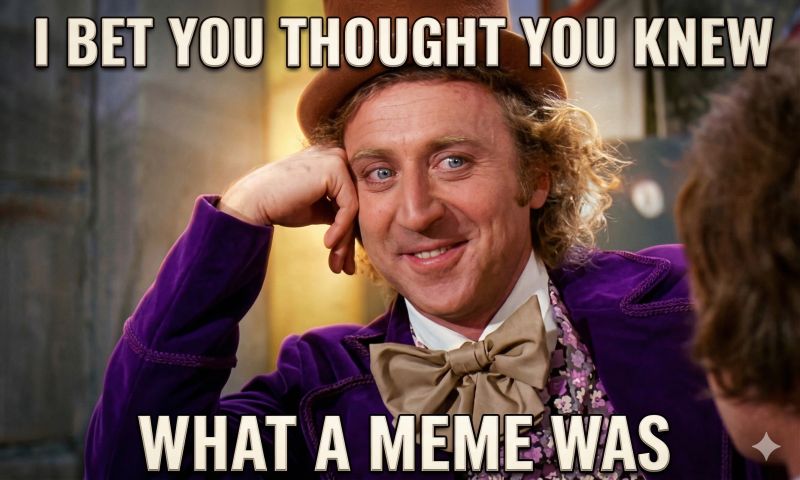
Claim
Memes are units of cultural transmission, Dawkins’s analogue to genes, that hop from brain to brain by imitation. They can harden into norms, identities, and shared fictions, recruit emotion and tribal defense, and behave like agents in how people protect or spread them.Thoughts
Coinage
The same coinage: evolutionary biologist Richard Dawkins in The Selfish Gene (1976) built meme from Greek mimema (“that which is imitated”) and shortened it to rhyme with gene, stressing memes as cultural analogues of genes.
What they become
Religions, ideologies, social hierarchies, and shared fictions like money or nation‑states work this way. Once they take root, they guide behavior, attract followers, punish dissent, and defend against criticism.
Old hardware
At a basic level, memes connect to ancient brain circuits like the amygdala and basal ganglia. They trigger fear, belonging, reward, novelty, or identity so defending or sharing them feels meaningful or urgent.
Identity load
At a higher level, memes attach to your self‑image and group identity. The meme becomes part of “who I am” or “who we are.” When someone attacks the meme, it feels like a personal or tribal threat, which makes people protect it.
What he said
“We need a name for the new replicator, a noun that conveys the idea of a unit of cultural transmission, or a unit of imitation. ‘Mimeme’ comes from a suitable Greek root, but I want a monosyllable that sounds a bit like ‘gene’. I hope my classicist friends will forgive me if I abbreviate mimeme to meme. … Examples of memes are tunes, ideas, catch-phrases, clothes fashions, ways of making pots or of building arches. Just as genes propagate themselves in the gene pool by leaping from body to body via sperms or eggs, so memes propagate themselves in the meme pool by leaping from brain to brain via a process which, in the broad sense, can be called imitation.”
(Dawkins, 1976, p 192)