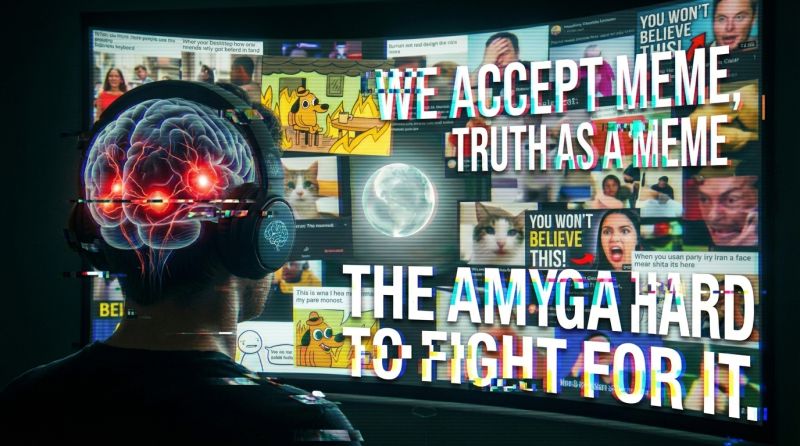
🧠🎭 We only accept truth as a meme ...
Claim
We only accept truth as a meme …
… so it never hits the amygdala hard enough to fight for it.
The brain doesn’t care about “truth.” It cares about keeping its model of the world intact. Anything that threatens that model feels like danger.
So we downgrade truth into memes. We turn destabilising facts into jokes, clips, and hot takes. That makes them easy to look at and easy to ignore.
Thoughts
Memes add distance. It’s not “this is happening to me and my people,” it’s “here’s some content about what’s happening.” Same event, different circuit. The closer it feels, the more the amygdala treats it like a real threat. The farther it feels, the more it becomes entertainment.
That’s how we can nod along to a meme and change nothing. The truth arrives as commentary, not as a constraint on how we live.
If we want truth to change behaviour, we have to change how it shows up: less irony, more skin in the game. Truth has to move from something we consume to somewhere we’re willing to stand.
Grounding
Powers and LaBar (2018) propose a taxonomy of psychological distancing, a neurocognitive model of how distance regulates emotion, and a supporting meta-analysis.