🧵 Built to last: how systems puppet themselves
Claim
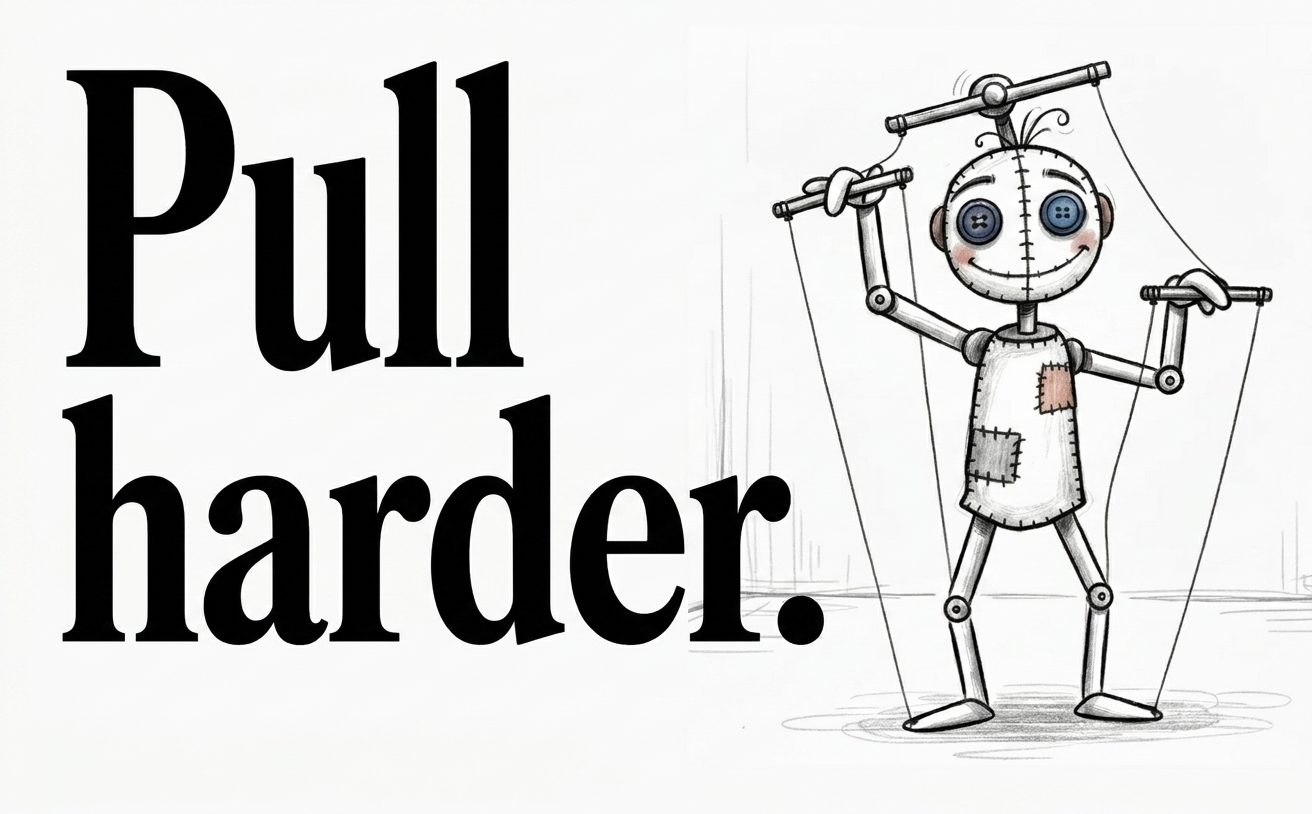
Durable systems rarely need to hold a whip. They make people want to pull the strings, because belonging and purpose feel good. That is how leaders and institutions get collaboration at scale without constant force.Thoughts
The Puppet Master’s Design
First, it sets a goal you can chase forever but never finish.
Then it turns that goal into a lived world:
- Rules that tell you what “good” looks like.
- Stories that make the rules feel noble.
- Rituals that make the story feel real.
Finally, it appoints interpreters, the people who translate the ideal into decisions, rewards, and punishments.
The Fuel: Human Currency
People keep showing up because the system pays in human currency: belonging, status, meaning, purpose. The submission feels like participation.
The Playbook in Action
We see this pattern whenever a system needs to survive its own failures:
- Religion: Promising salvation or enlightenment. When a prayer goes unanswered, the blame falls on a “lack of faith.” When a priest is caught in a scandal, the blame falls on the “flawed man” or the “dodgy business” of the interpreter, never the core promise or the institution’s divine mandate.
- Political Ideologies: Socialism or the “American Dream.” If the economy fails or the dream stays out of reach, the system blames “corrupt officials” or “lazy individuals” while the Utopian vision remains pure.
- Constitutions: The American Constitution is a secular “holy text.” We treat its flaws as “misinterpretations” by judges or politicians, preserving the document as a perfect, unattainable ideal of justice.
- Corporate Culture: The “Mission Statement” that promises to change the world. Employees burn out, but the mission stays noble; it was just “bad management” or “poor alignment.”
- Enterprise Software: Vendors sell a “digital transformation” story that is often unimplementable. When the expensive tools fail to deliver, the blame falls on the “low-level users” who didn’t adopt it correctly or the “internal IT team” that failed to integrate it, never the flawed software or the impossible story.
How the System Defends Itself
When someone questions the rules, the system often defends itself through its own members. The dissenter gets minimized, dismissed, or shamed until they stop pushing, or stop belonging.
And when the system fails, it protects the ideal by blaming the interpreter: a bad leader, a corrupt priesthood, a misguided manager. The core promise is never at fault.
The Totem: Unquestioned Reality
This cycle creates a shared model of the world that self-reinforces within its own echo chambers. It becomes unquestioned and unbeatable, like a totem pole standing in the center of a village. You cannot argue with it; it just is.
When everyone is trying to protect the same model, the group develops a collective immune response to any contradictory evidence. The vision stays pure and always unattainable, the order stays stable, and the machine survives.
Case Study: The AGI Legitimacy Machine
The AI industry has built its own version of this system. The narrative of inevitable superintelligence justifies a massive concentration of power and resources today. Like a religious institution promising salvation, the AGI story creates meaning and purpose that transcends individual failures.
It is a perfect legitimacy machine:
- The goal is unattainable: AGI is always just around the corner, keeping the chase alive.
- The ideal is protected: If a model fails or a company stumbles, the blame falls on the “interpreters” (the current hardware, the specific tuning, the management), never on the core vision of superintelligence.
- The distance matters: People closest to the research often express caution because they see the machinery. Those furthest away spread confidence because they have bought into the institutional story.
The technology is new, but the protocol is as old as the first campfire.
May you see through its flames.