🧠🧱 Our stubborn refusal
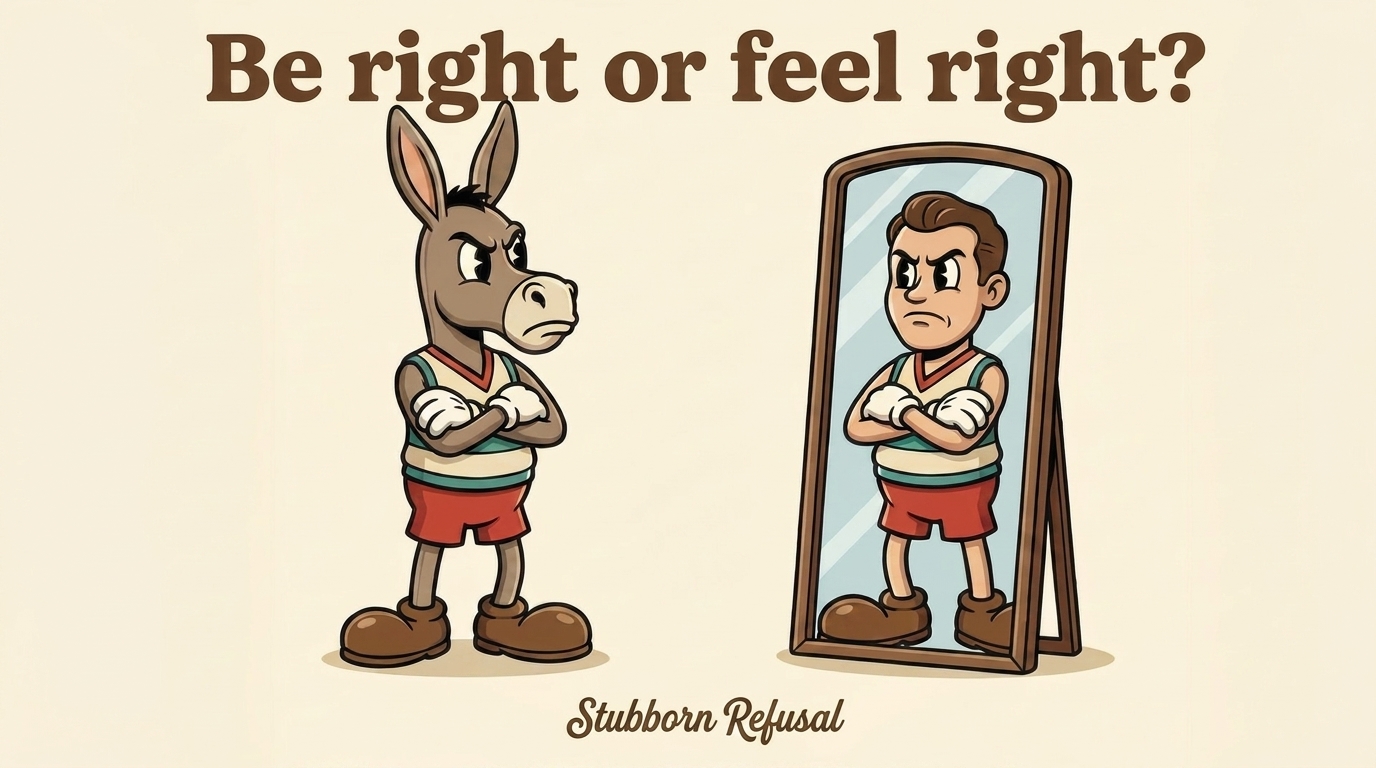
Claim
Ask people if they’d change their mind given new evidence, and most will say yes. Put them in the situation, and the mind often defends stability over accuracy, especially when a belief has fused with identity, tribe, or moral status.Thoughts
Remember the degree you poured four years and six figures into? Someone shows you data proving that people without the credential are outperforming you, and the degree itself means nothing in your field. You do not say “thank you for the clarity.” You get defensive. You explain why the data misses the deep, unquantifiable value of a proper education.
If you accept their facts, you are not an educated professional anymore. You are just someone who bought a very expensive piece of paper.
“Just give them the facts” fails because of rigidity, not stupidity. A rigid belief is structural. Pull it out and the whole thing wobbles. Your brain fights to keep it in place.
The brain balances accuracy with other drives
When you evaluate a new claim, you are rarely solving for objective truth alone. Your brain is balancing accuracy against other needs: protecting your identity, fitting in with your group, maintaining status, and keeping your mental model stable.
Even when you actively try to be accurate, the machinery weighs comfort, agency, and the story you tell yourself about who you are. When a new fact creates a massive tear in your identity (like admitting a four-year degree was a waste), getting it right often loses to keeping your story intact. The brain treats the fact not just as data to be weighed, but as a threat to be defended against.
Notice if you feel the urge to push back here.
Why corrections struggle
Remove a belief without a better replacement and you create a hole. Your mind rejects the update because a broken story is worse than a wrong story. Often the replacement that gets shoved in is just more misinformation.
Debunking almost always means repeating the lie. Familiar feels true, so every correction can accidentally feed the beast you are trying to starve. Over a lifetime this compounds: decades of exposure (even from debunking) runs the loop again and again. Both versions stay in memory, competing. The older, more familiar one often wins.
Correction works best when identity stakes are low, the source is trusted, or people are “prebunked” (warned about a false claim before encountering it) before exposure. On polarized topics, those conditions are much harder to find.
In practice, debunking often has limited impact, especially on identity-linked beliefs. A meta-analysis of climate, COVID, and related science corrections found that debunking attempts were, on average, weak or undetectable, with effectiveness depending heavily on topic and how the correction was delivered.
What rigidity looks like in the wild
People dodge inconvenient facts and cling to confirming ones. They attack the messenger’s motives, generate counter-arguments on autopilot, and dig in harder when pressed.
We call these cognitive biases, which makes them sound like mental errors. They are patterned mistakes, but from the inside, the person is just “thinking clearly.” From the outside, a firewall is blocking traffic.
People rarely choose to be wrong. They often choose to protect identity, status, and belonging, with accuracy sometimes a distant third.
It is easy to spot this defense routine in others.
Turn the camera around
Bypassing someone else’s firewall is exhausting. You have to stop arguing facts, preserve their dignity, and offer a replacement story that hurts less than being wrong. You are handling their fear of looking foolish or losing standing.
You do not have to do it. Their rigidity is not your responsibility.
The real value of understanding this machinery is catching yourself.
When a new fact makes you angry, notice the firewall going up. When you generate counter-arguments on autopilot, stop. What structural belief is under threat? What happens to your identity if the fact is true?
You cannot force anyone else to drop their defenses. The only load-bearing wall you can move is your own.