PredictiveProcessing - Tag - behaviorengineering.ai

 PredictiveProcessing

Human-Condition · Mental-Processes

🪞 Why does the brain keep selling you a new "me"?

  • Your sense of self is a brain construct: the brain blends what it already expects with what the senses pick up now, and you take that mix as who you are.
  • Your inner voice helps you plan and turn events into a story of who you are. When that voice loops as chatter (rumination and catastrophizing), you replay the same worry without solving anything.
  • Upbringing and a negativity bias (bad news hits harder than good) write early self-stories. Left alone, you keep using those stories as an adult.
  • Conscious attention can break automatic patterns. Small wins and deliberate focus change the perception box: the bounded window you treat as the whole world.
Read the article
3 minutes
/human-condition/2026-05-28-why-humans-keep-building-pyramids/skull.jpg

Human-Condition · Mental-Processes

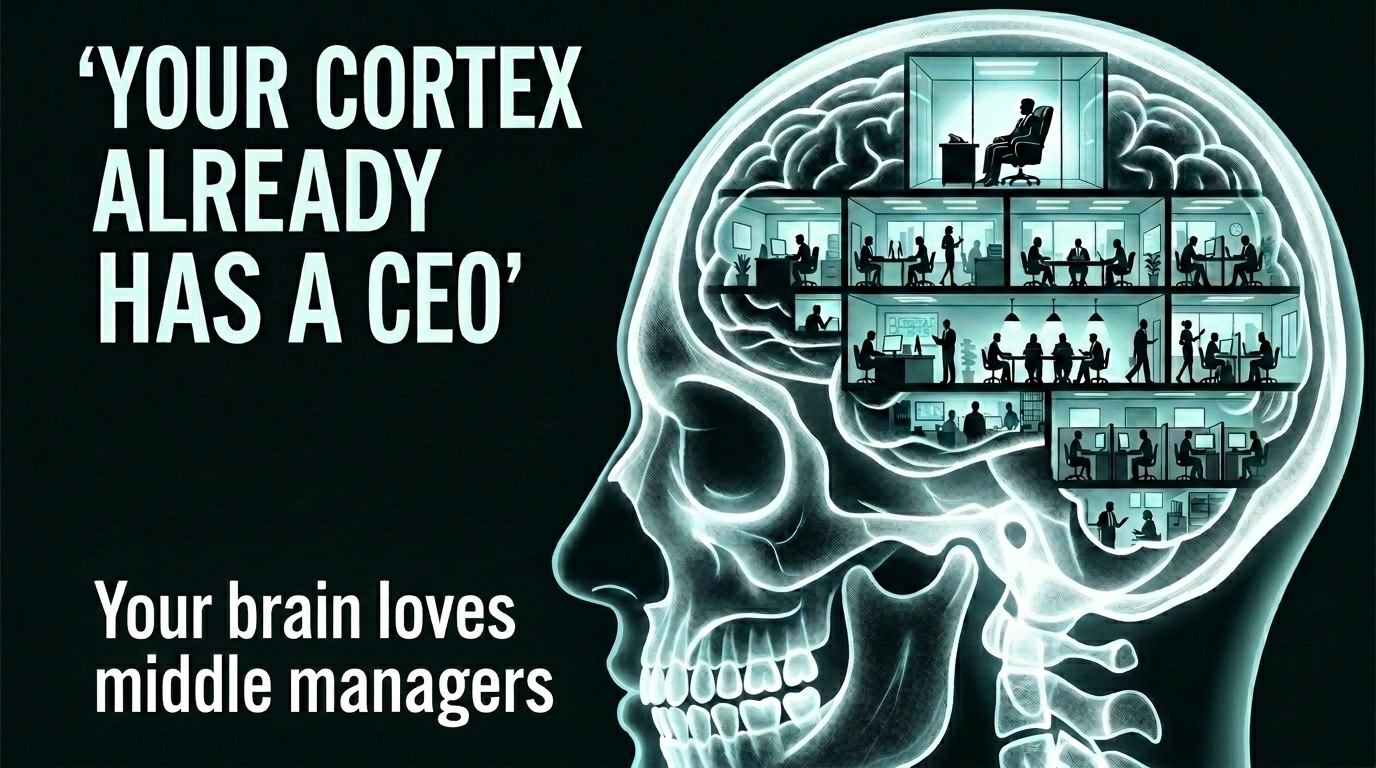
🏢🔺 Why does every group organize into a pyramid?

Brains compress the world into layers and rank, then route attention upward, so local noise gets summarized before it reaches a decision. That is why pyramid-like groups feel obvious: a few signals at the top, many roles below, a ladder everyone can read. Hierarchy is an attractor: groups keep sliding into a pyramid. Flatter systems need counter-design (written rules and shared maps), because the nervous system is already used to climbing.
3 minutes

Mind-Infrastructure

🧠🔮 Your brain is a controlled hallucination

  • Your brain is a prediction machine instead of a passive camera. It builds a best-guess model of the world and verifies it against sensory data.
  • “Reality” is the brain’s strongest guess, optimized to minimize prediction errors instead of showing objective truth.
  • Optical illusions are strong priors in action. They generate hallucinations whenever sensory data is noisy, ambiguous, or novel.
  • The Free Energy Principle explains this as one continuous loop: predict, compare, update, and repeat.
Read the article
2 minutes